What is the dry process for LIB electrode materials?
The dry process for lithium-ion battery (LIB) electrode manufacturing is a method that does not use solvents or water. In recent years, its clear cost advantages have led to increasing adoption by battery manufacturers, raw material suppliers, and research institutions around the world. While there are various types of dry processes, all of them require homogeneous mixing without segregation during electrode fabrication as a fundamental prerequisite.
Source: Gerl, S. (2024) “Production and scale-up of dosable structured anode and cathode dry mixes in a one-pot process with intensive mixers” from Abstract “65” Battery Symposium Japan”
Raw Material Processing Overview
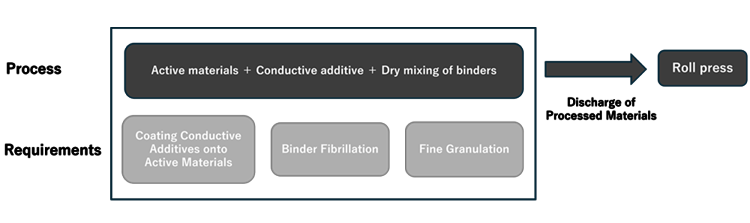
Requirements for Coating Conductive Additives onto Active Materials
- Avoid incomplete mixing or segregation caused by differences in specific gravity between active materials and conductive additives
Requirements for Binder Fibrillation
- Control of shear force and material temperature
Requirements for Fine Granulation of Processed Material
- Improve handling efficiency for the next step
Solution Proposals / Processing Example for Dry Process
A series of processes, like the ones listed below, can be completed using a single Eirich Intensive Mixer in a one-pot process.
This method is expected to be used not only for lithium-ion battery manufacturing but also for next-generation batteries, such as all-solid-state batteries.
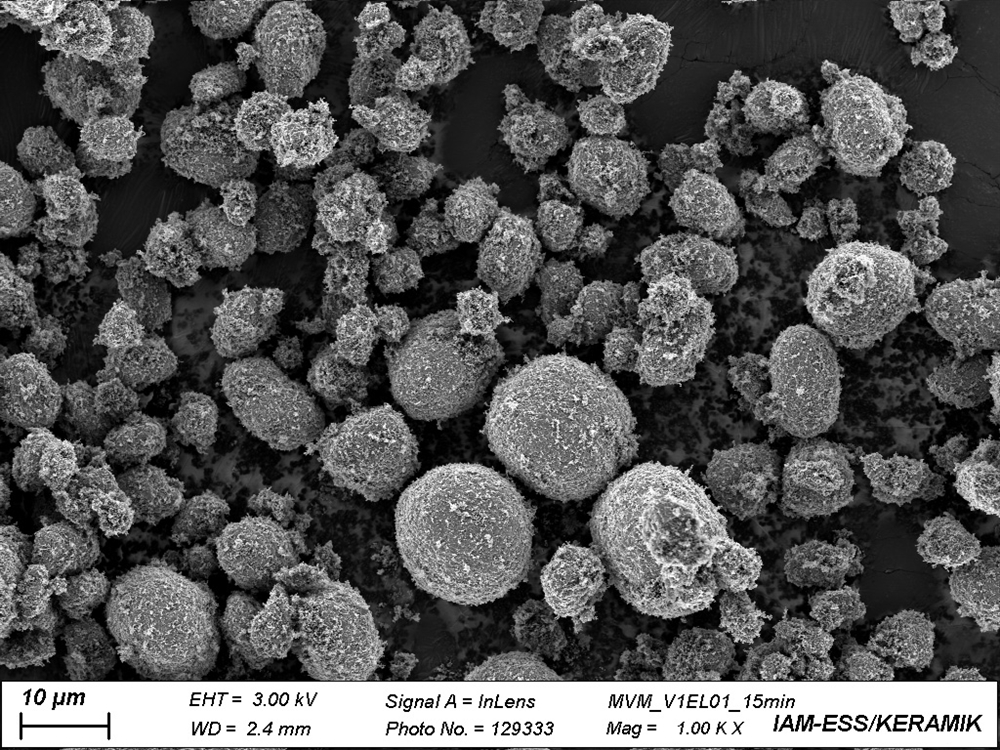
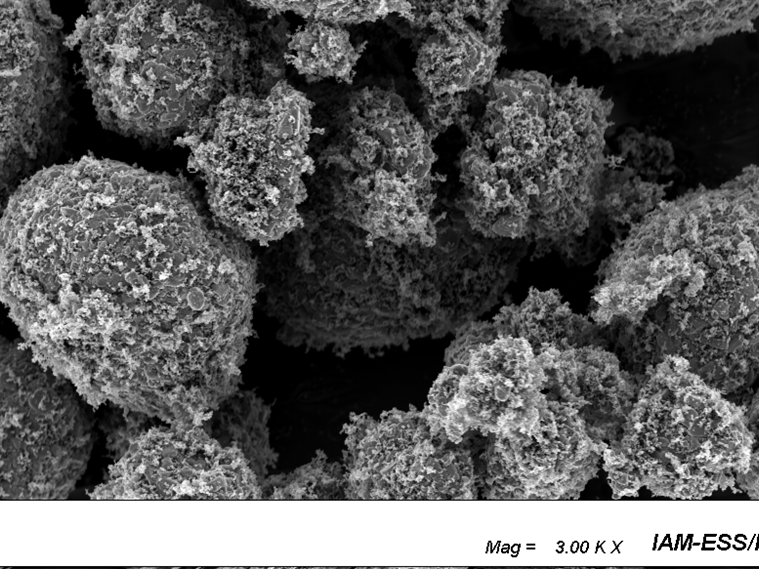
Carbon Coating of Active Materials
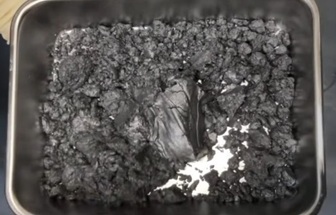
Challenge: Incomplete mixing or segregation can occur due to differences in specific gravity.
Mixing result of active material and conductive additive with different specific gravities: No visible segregation or agglomeration observed (see image).
By adjusting operating conditions, homogeneous mixing, dispersion, and defibration of raw materials with different specific gravities can be achieved.
At our Technical Center, we offer sample preparation using actual raw materials and basic SEM observations.
Binder Fibrillation
Challenge: Control of shear force and material temperature
Condition after binder mixing: The material clumps together when squeezed (see image).
By adjusting the rotation speed of the mixing tool, the shear force needed for processing can be controlled.
At our Technical Center, you can try preparing samples using our test equipment.
Fine Granulation of Fibrillated LIB Electrode Materials
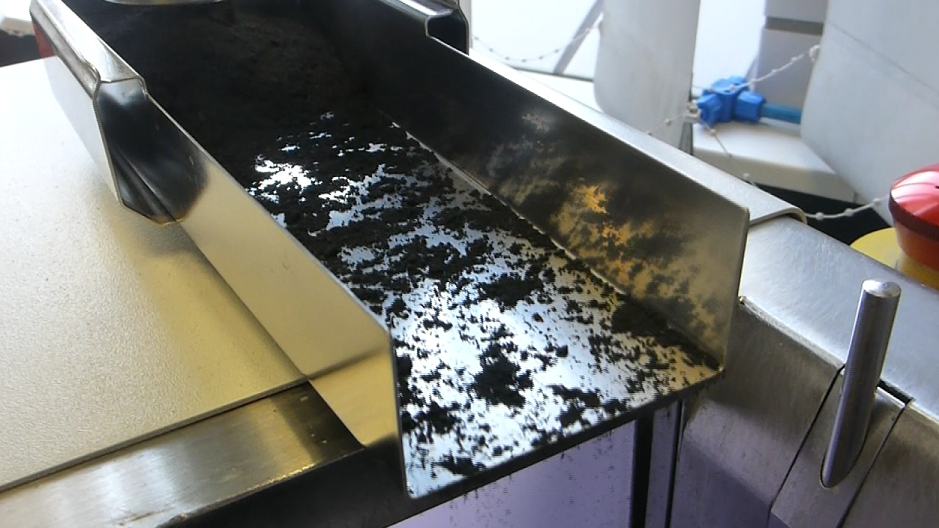
Challenge: Improve handling efficiency for the next step
Condition after fine granulation: The material is evenly spread on the tray (see image).
By adjusting the operating conditions, the fibrillated material can be processed into fine granules. This helps improve handling in the next step.
You can try this process using our test equipment at the Technical Center.
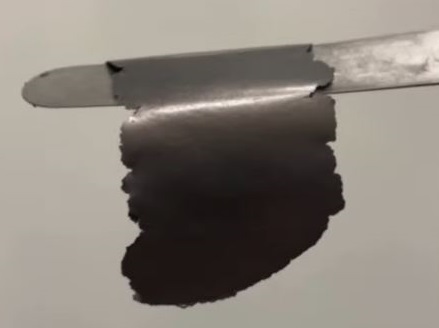
Processed material can be formed into sheets
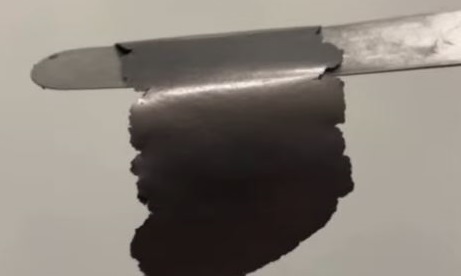
By rolling the discharged material with rollers, it can be formed into sheet shapes.
The image shows a sample processed with our test equipment at the Technical Center, manually rolled to form sheets.
Related Videos
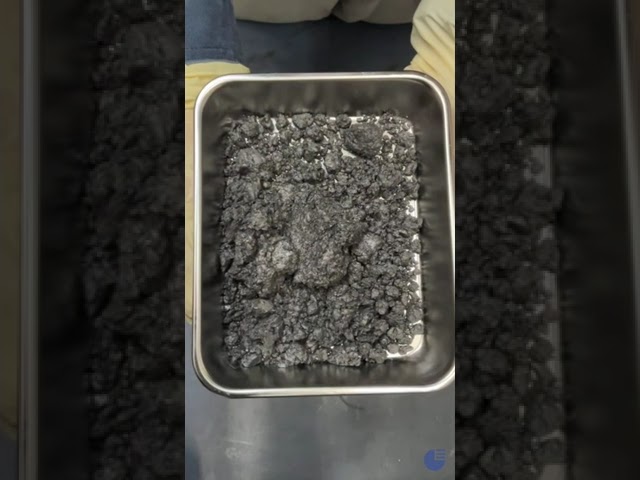
Short Video on Fibrillation
This is a 1-minute short video featuring the “fibrillation” process introduced in our processing example.
Recommended Products
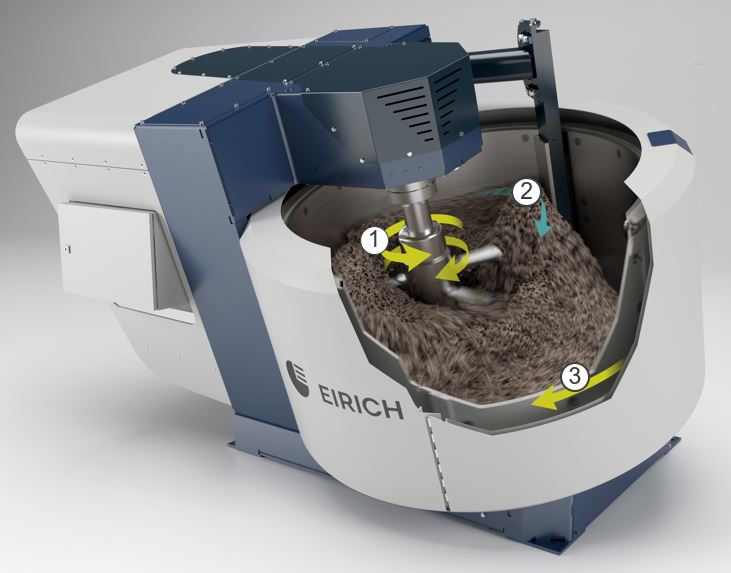
Eirich Intensive Mixer is a high-speed mixer and granulator designed for a wide range of processing tasks involving raw materials, mixtures, and compounds.Optimal material processing is achieved by selecting the appropriate mixing tool shape and rotation speed according to the application.
By adjusting the operating conditions, a single machine can handle multiple processes such as mixing, granulation, kneading, and slurry preparation.The mixer features a jacketed mixing pan for both cooling and heating, and offers a wide range of customizable options to accommodate various processes.
Advantages of the Eirich mixing principles
- Eccentrically positioned rotor tool (mixing tool)
The rotor tool shape, rotation direction, and speed range can be selected to suit the application. - Tool Set (scrapers)
It scrapes off raw materials adhering to the inner wall and bottom of the mixing pan, while simultaneously promoting efficient material transfer to the rotor tool. - Mixing Pan (mixing vessel)
Through rotation, all raw materials in the mixing pan are continuously supplied to the rotor tool.
Unique Mechanisms
- Short mixing time and high homogeneity
- Capable of processing raw materials with varying specific gravities
- The rotating mixing pan promotes material movement and reduces residue.
- By selecting the rotor tool shape and adjusting the mixing pan speed, the system can handle complex material processing
- Process integration enables compact and energy-efficient production systems
- Setting optimal operating parameters ensures consistent and reproducible material processing
Below is an overview of the equipment best suited for the process introduced above, along with the test machines currently available at our Technical Center.If you would like more information, please feel free to contact us via the inquiry form.
Eirich Intensive Mixer
| Type | Capacity (L) | Operation Data Log | Cooling Jacket Availability | Test Unit Availability |
|---|---|---|---|---|
| EL1 | 1 | 〇 | × | 〇 |
| EL5 Profi Plus | 5 | 〇 | 〇 | 〇 |
| EL10 Profi Plus | 10 | 〇 | 〇 | × |
| R05T | 40 | 〇 | Operation | 〇 |
| RV12W | 400 | 〇 | Operation | 〇 |
Click here for product details.
Test Unit Availability
here
.
If you would like more information, please feel free to contact us via
the inquiry form
.