Why granulation is performed before tabletting
Tableting is the process of compressing powder materials into solid tablets. To ensure successful compression, the powder must exhibit good fillability (flowability) into the die cavity and compressibility. This requires an appropriate particle size distribution, particle shape, and favorable frictional and deformation properties. In general, powders with very fine particle sizes tend to have poor flowability, which can lead to inconsistent feeding into the tablet press. To address this, the raw materials are mixed and granulated prior to tableting. Granulation improves the powder’s flowability and helps maintain uniform tablet weight during compression.
Granulation enables better control over tablet formability, hardness, and disintegration behavior, which helps ensure consistent formulation uniformity.

Challenges
- Inhomogeneity of raw materials and inconsistent mixing
- Difficulty in controlling particle size distribution
- Handling issues in subsequent processes
Requirements
- Homogeneous mixing to ensure consistent content uniformity
- Excellent granule flowability for stable feeding and compression
- Reliable handling for smooth transition to subsequent processes
Source: Takeuchi, H., Arima, H., Hirayama, F., & Yamamoto, H. (Eds.). (2016). Saishin Seizaigaku (4th ed.). Hirokawa Shoten.
Solution Proposals / Processing Example for Granulation Before Tabletting
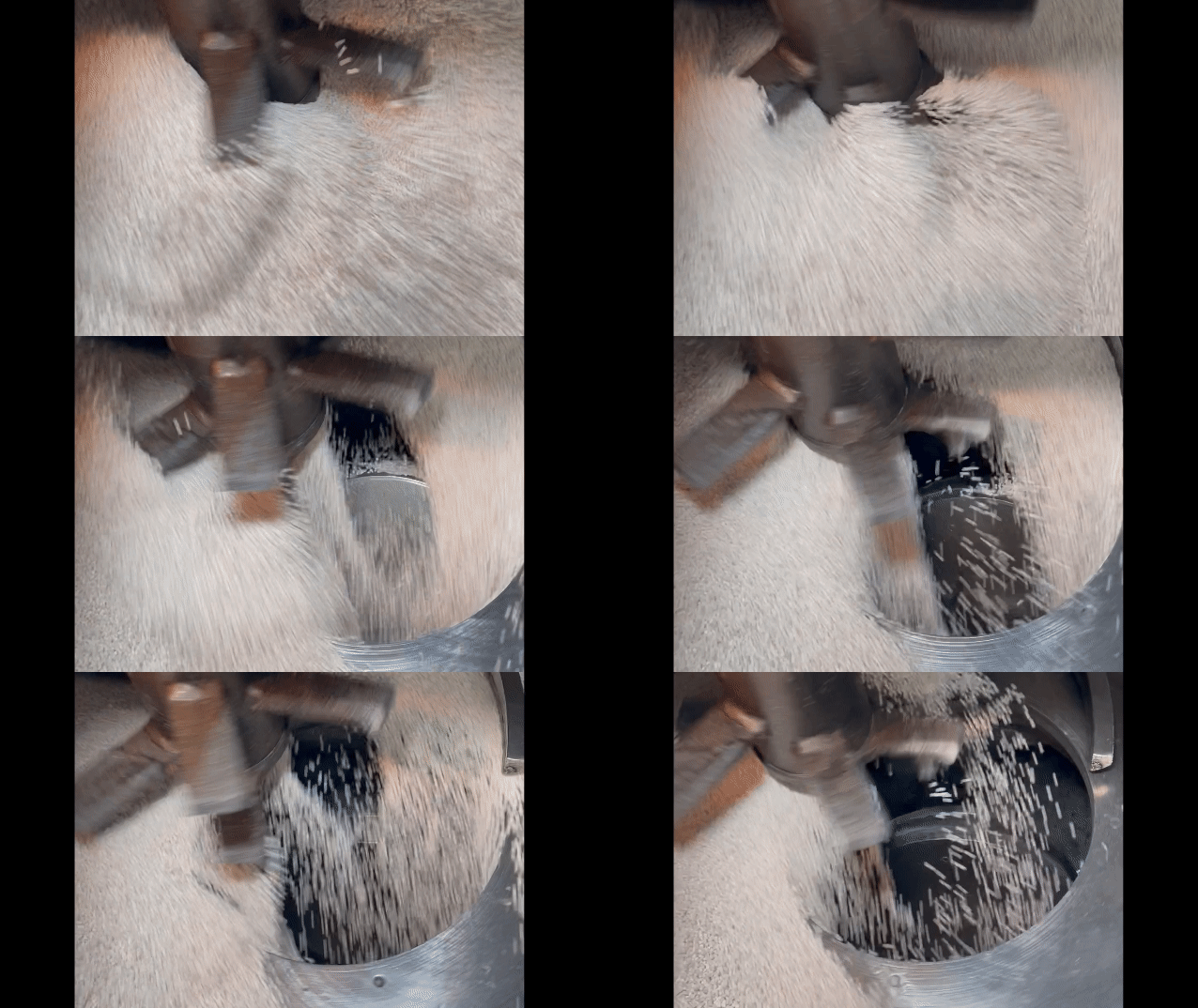
We present a processing example of granulation before tabletting using EIRICH CleanLine.
You can visually confirm the effects of granulation by comparing SEM images taken before and after processing.
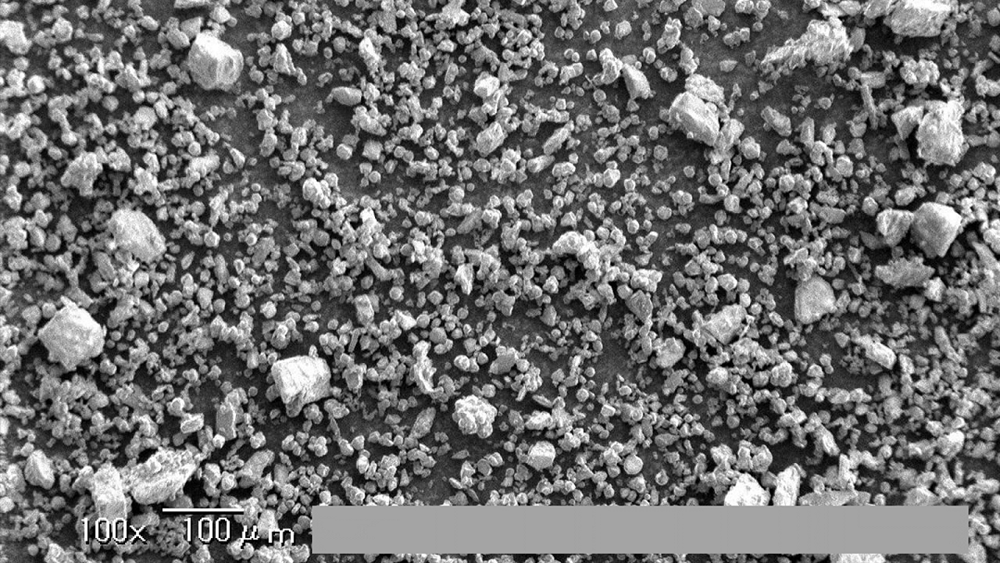
SEM Image Before Processing
Particles are small and inhomogeneous. Poor flowability is observed.
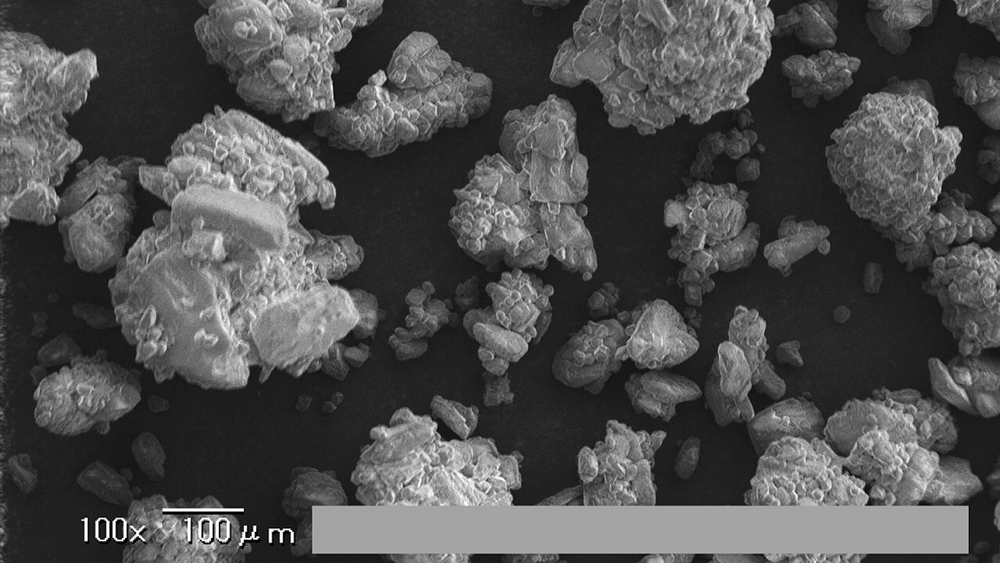
Granules After Mixing and Granulation
Particles become larger through the mixing and granulation process.
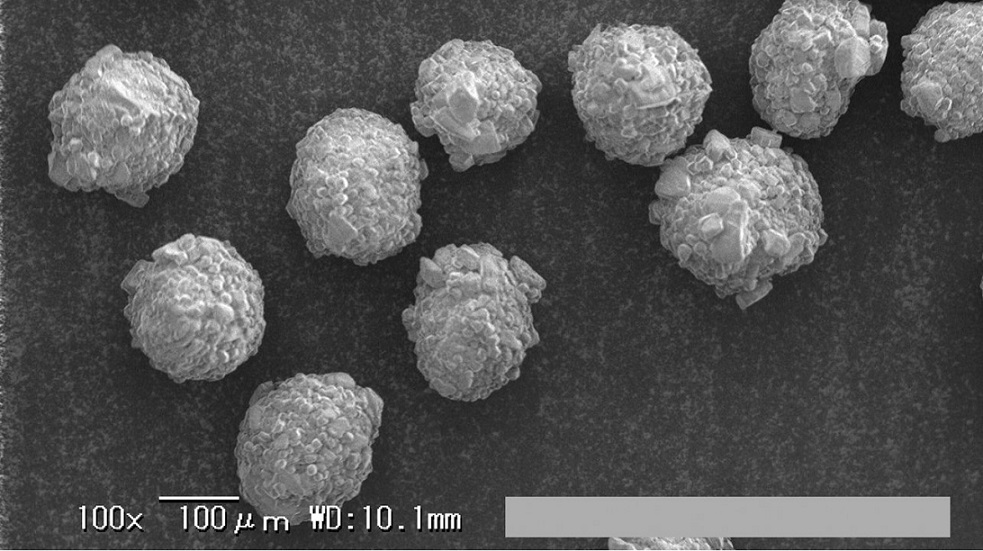
Granules After Processing (Spheronization)
Particles become larger through the mixing and granulation process.
In addition to increased particle size, the granules are formed into near-spherical shapes.
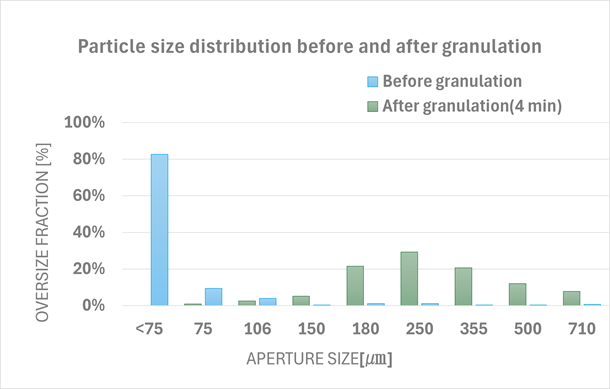
Particle Size Distribution (Example)
Before granulation: Fine particles dominate, with a high proportion retained on sieves with small mesh openings.
After granulation: Particles aggregate, showing a smooth, bell-shaped distribution peaking around 180–355 μm.
This indicates that granulation contributes to uniform particle size distribution.
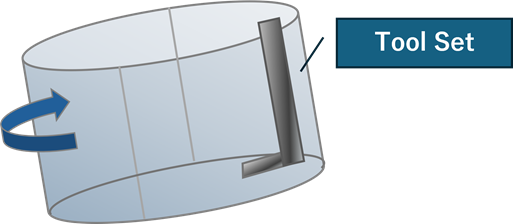
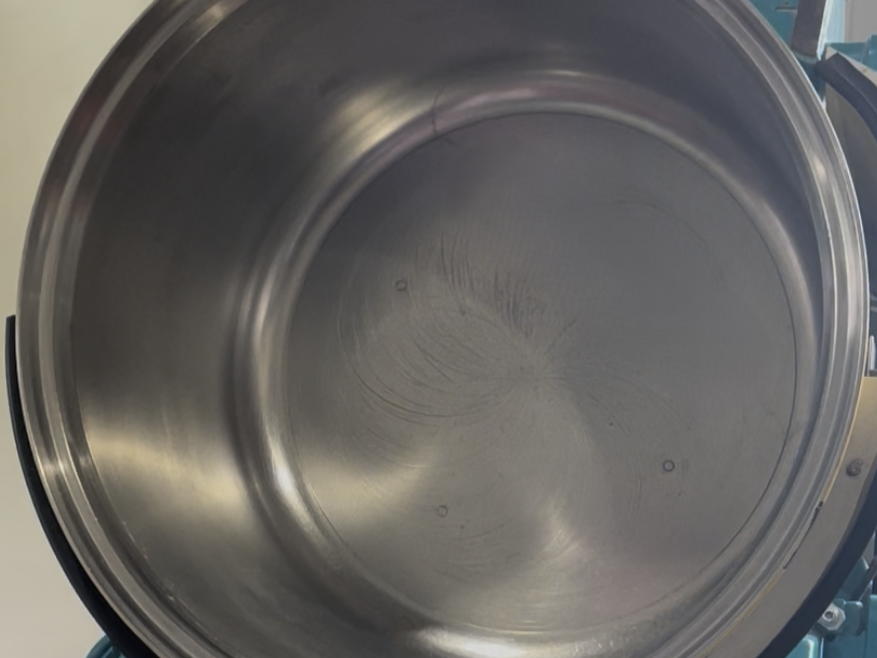
Automatic Wall Scraping with Tool Set
The Tool set automatically scrapes off material adhering to the inner wall of the Mixing pan.
This reduces manual scraping during processing and improves mixing uniformity by removing adhered particles.
Benefits include lower operator exposure risk, reduced particle size variation, and higher yield.
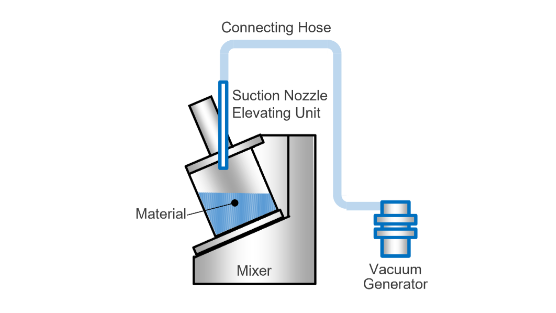
EIRICH Smart Discharger (Optional)
We introduce a pneumatic (air-conveying) discharge system as a suitable method for this process.
A nozzle is inserted into the Mixing pan, and material is discharged via suction through the upper hose.
No operator intervention is needed during discharge, and the product is released without damage.
The discharge destination can be freely selected, such as storage containers or the next process.
Voices from our customers
“The granulated particles are well-suited for tableting, allowing us to consistently produce tablets with higher hardness than before.”
“Thanks to the system’s anti-adhesion measures, manual scraping during processing is no longer necessary.”
“Compared to our previous equipment, we appreciate how uniformly the materials mix and how effectively it prevents clumping.”
Recommended Products
EIRICH CleanLine was developed for processing raw materials that require high levels of hygiene control—such as pharmaceuticals, food products, and advanced materials—while retaining the unique mixing principle of EIRICH Intensive Mixer.Designed with hygienic specifications that prioritize cleanability and corrosion resistance, the system enables easy maintenance of sanitary conditions.There are two main series: one manufactured in Japan and the other in Germany. The Japan-made series is designed to meet the needs of customers in the pharmaceutical and health food industries, and complies with GMP guidelines covering equipment design, manufacturing, inspection, installation, and commissioning.
Advantages of the Eirich mixing principles
1. Eccentrically positioned rotor tool (mixing tool)
The rotor tool shape, rotation direction, and speed range can be selected to suit the application.
2. Tool Set (scrapers)
It scrapes off raw materials adhering to the inner wall and bottom of the mixing pan, while simultaneously promoting efficient material transfer to the rotor tool.
3. Mixing Pan (mixing vessel))
Through rotation, all raw materials in the mixing pan are continuously supplied to the rotor tool.
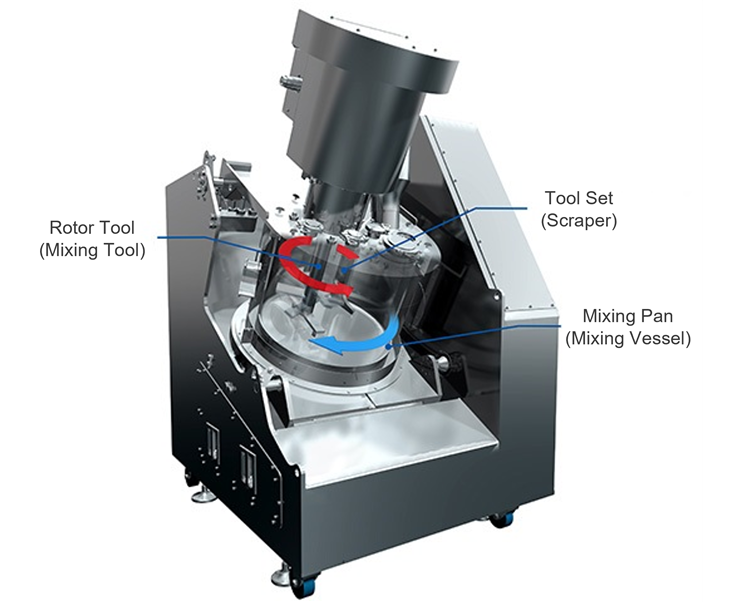
Advantages of CleanLine
- Selecting the appropriate rotor shape and adjusting its rotational speed ensures optimal material processing.
- By adjusting the shear force, particle size and density can be controlled. This makes it possible to achieve particle size distributions such as D50 values ranging from below 200 μm to approximately 1 mm.
- By controlling the temperature through a jacketed structure, it is possible to perform granulation under cooling or heating conditions, and to process materials that are sensitive to temperature changes.
- Excellent material circulation and dispersion are achieved during both kneading and subsequent slurry formation.
EIRICH CleanLine
This mixer features a hygienic design compatible with GMP standards.
| Type | Capacity (L) | Reverse Jet Nozzle | Cooling/Heating | GMP Compliance | Product Discharge |
|---|---|---|---|---|---|
| Type C5 | 5 | × | Air/Liquid | 〇 | Detachable Mixing Pan |
| Type C40 | 40 | 〇 | Air/Liquid | 〇 | Detachable Mixing Pan/ESD |
| Type C400 | 400 | 〇 | Air/Liquid | 〇 | ESD |
Click here for product details.
Test Unit Availability
here
.
If you would like more information, please feel free to contact us via
the inquiry form
.